Vitamin C in skincare is not a single product type or a guarantee of a particular result. It is a topical cosmetic ingredient family whose behavior depends on the form used, the surrounding formula, and how well the product protects that formula from degradation.
In skincare, vitamin C means a topical form of ascorbic acid or a related derivative used in a cosmetic formula. L-ascorbic acid is the best-studied form, while derivatives such as magnesium ascorbyl phosphate and ascorbyl-6-palmitate have different formulation characteristics. The ingredient name alone cannot establish concentration, stability, or expected performance.
Explore BABOR vitamin C skincare formats
That distinction matters when reading an ingredient list. A familiar name may identify the vitamin C form, but it does not reveal the complete delivery system, packaging, pH, or testing behind the finished product. Understanding the ingredient's identity and role in a formula provides the foundation for interpreting those details with greater precision.
What Is Vitamin C in Skincare?
Vitamin C in skincare is a topical ingredient family built around ascorbic acid and its derivatives. It is studied for cosmetic roles including antioxidant activity, photoprotective effects, support for collagen formation, and effects on the appearance of pigmentation. However, the ingredient name alone does not describe how a finished product will behave on skin.
Ascorbic acid is the name commonly used for vitamin C in cosmetic formulations. Among topical forms, L-ascorbic acid is the most biologically active and best-studied form. It is also a water-soluble, unstable molecule, and delivering it effectively through a topical formula presents a technical challenge. The scientific literature reviews vitamin C through several connected questions: how stable the ingredient remains, how it is delivered, and what cosmetic effects may be observed after application.
That is why formula design matters. A product is not defined only by whether its label says vitamin C. The form of vitamin C, the surrounding ingredients, the formula's acidity and physical structure, and its packaging can all influence stability and delivery. Research identifies both vitamin C instability and difficulty with topical delivery as important formulation challenges, rather than treating the raw ingredient as an isolated active.
For example, L-ascorbic acid's performance is connected to the conditions in which it is formulated. The research literature reports that acidity below pH 3.5 can improve its stability and permeability, while other formulations may use a different vitamin C derivative or delivery approach. These details help explain why two products that mention vitamin C may not be directly interchangeable.
In practical label language, vitamin C describes the ingredient category; it does not guarantee a specific concentration, stability profile, or cosmetic result. Understanding those distinctions makes it easier to read ingredient lists with appropriate precision and to separate evidence about topical vitamin C from assumptions based on marketing language.
Sources: research on ascorbic acid in cosmetic products and a review of topical vitamin C forms, stability, and delivery.
Which Forms of Vitamin C Appear on Skincare Labels?
On a skincare label, vitamin C may appear as ascorbic acid or as a related derivative. These names describe different chemical forms of the ingredient family, not interchangeable guarantees of performance. Reading the specific INCI name is therefore more informative than relying on the phrase "vitamin C" alone.
L-ascorbic acid
L-ascorbic acid is the form most often discussed in topical vitamin C research. It is described in the scientific literature as the most biologically active and best-studied topical form. It is also hydrophilic and relatively unstable, which means the surrounding formula, acidity, packaging, and handling can influence how well it is maintained over time. A label identifying L-ascorbic acid tells you the form used, but it does not by itself establish the formula's stability or expected cosmetic result.
Because L-ascorbic acid can be challenging to formulate, a product may instead use a derivative. Common examples include ascorbyl-6-palmitate and magnesium ascorbyl phosphate. These are described as esterified, lipophilic forms that are stable at neutral pH. Other derivative names found in the literature include sodium ascorbyl phosphate, disodium isostearyl 2-O L-ascorbyl phosphate, ascorbic acid sulphate, and tetra-isopalmitoyl ascorbic acid. The exact spelling and spacing can vary by labeling convention, so the complete ingredient list matters.
Why the distinction matters
Derivatives differ in properties such as oil and water affinity, stability, and how they are handled by a formula. In one comparative study, sodium ascorbyl phosphate and magnesium ascorbyl phosphate were more stable than ascorbyl palmitate under the tested conditions. That finding describes a formulation comparison, not a universal ranking of every product.
Evidence also does not support assuming that every derivative behaves identically to L-ascorbic acid. A review cites a study in which daily application of several derivatives did not increase skin levels of L-ascorbic acid. The practical reading is simple: identify the precise form, then consider the complete formula and its evidence. The label can tell you which vitamin C-related ingredient is present; it cannot, on its own, prove conversion, stability, concentration, or suitability for your skin.
Read the scientific review of topical vitamin C forms and derivatives.
What Can Topical Vitamin C Do for Skin?
Topical vitamin C may support several visible aspects of skin appearance, but the result depends on the form, formula, and how well the finished product delivers the ingredient. Research has examined topical vitamin C for antioxidant activity, photoprotection, the appearance of skin aging, and uneven pigmentation. These areas describe cosmetic research interests, not a promise to treat a medical condition.
One reason vitamin C is associated with skin firmness is its relationship to collagen. Reviews describe research into collagen synthesis, collagen fiber stabilization, and reduced collagen degradation. In practical terms, this gives vitamin C a role in formulas designed to support a smoother, more resilient-looking complexion. It does not mean that every product containing a vitamin C derivative will produce the same visible effect.
Vitamin C has also been studied in relation to melanin formation, which is relevant to the appearance of uneven tone and pigmentation. The evidence should be interpreted carefully. Clinical studies of topical vitamin C efficacy remain limited, and the ingredient name alone cannot establish the strength, consistency, or timing of a cosmetic result.
Formulation is central to that distinction. L-ascorbic acid is the most extensively studied topical form, yet it is also unstable and presents delivery challenges. Derivatives may behave differently in a formula, so concentration, vehicle, pH, packaging, and application instructions all affect how the product should be understood. A label can identify an ingredient, but it cannot by itself prove performance on skin.
For a broader explanation of vitamin C's role in skin, see BABOR's dedicated guide. Keeping that benefits discussion separate from ingredient literacy makes it easier to assess what a particular formula may contribute without treating a cosmetic ingredient as a medical treatment.
Why Does Vitamin C Stability Matter?
Stability matters because vitamin C can change when the formula is exposed to environmental conditions or when its ingredients interact over time. Ascorbic acid is sensitive to air and light, and it can be degraded through chemical and photochemical oxidation. That means the ingredient list alone cannot tell you how well a finished cosmetic formula protects its vitamin C.
Air and light can influence oxidation
Exposure to oxygen and light are important variables in a vitamin C formula. In one cream-formulation study, oxidative degradation in darkness was reported to be about seventy times slower than photolytic degradation under light. This finding comes from a specific study system, not a universal shelf-life rule. It illustrates why packaging and handling are part of formulation performance. Opaque or otherwise protective packaging may help limit exposure. The formula still needs to be assessed as a complete system.
Formula pH and the vehicle change the formulation environment
pH can affect the behavior and stability of ascorbic acid. Research on L-ascorbic acid has reported improved stability and permeability at a pH below 3.5. Other research found that degradation increased as pH increased in tested emulsified systems, while the emulsions protected ascorbic acid better than aqueous solutions. These findings should not be turned into a universal instruction to seek one pH. The relevant pH depends on the vitamin C form, the rest of the formula, and the intended cosmetic use.
The vehicle also matters. In a cream study, light-associated breakdown was affected by active concentration, pH, viscosity, and other formulation characteristics. Physical stability of the cream was identified as important to stabilizing the vitamin. In another cited formulation, ferulic acid was described as helping stabilize L-ascorbic acid while contributing to an acidic environment. This does not mean that one supporting ingredient guarantees stability in every product.
Packaging is part of the evidence
Because stability and topical delivery are recognized formulation challenges, a meaningful evaluation considers more than the name of the active. Ask which vitamin C form is used, how the formula is designed, and whether the packaging limits unnecessary exposure to air and light. A label cannot establish a guaranteed oxidation timeline, storage temperature, or performance outcome by itself. Those details depend on the tested product system and its directions.
Explore BABOR ampoule concentrate formats
Sources: research on ascorbic acid stability in creams, a review of topical vitamin C forms and formulation, and research on ascorbic acid in emulsified systems.
How Do You Read Vitamin C on an Ingredient List?
Reading a vitamin C label starts with identifying the ingredient name, not looking for the words "vitamin C" alone. Ascorbic acid is the ingredient name commonly associated with vitamin C in skincare. You may also see names for derivatives, including ascorbyl-6-palmitate, magnesium ascorbyl phosphate, sodium ascorbyl phosphate, or tetraisopalmitoyl ascorbic acid. These names indicate different forms of the vitamin C family, not interchangeable proof of the same formula behavior. A scientific review describes L-ascorbic acid as the most biologically active and well-studied topical form, while also discussing several derivative forms.
What ingredient order can tell you
For cosmetics marketed in the United States, ingredients are generally declared in descending order of predominance. In practical terms, ingredients appearing earlier in the list are present at higher relative levels than those appearing later, subject to labeling rules. The U.S. Food and Drug Administration explains that ingredients present at 1 percent or less may be listed in any order after the ingredients present above 1 percent. That caveat matters: once you reach this part of the list, position alone cannot reliably rank the ingredients by amount. Review the FDA cosmetic labeling guidance for the applicable convention.
Why the list does not reveal the whole formula
An ingredient list usually does not provide the exact concentration of vitamin C. The FDA guidance notes that cosmetic ingredient concentrations need not be declared by regulation. Therefore, seeing ascorbic acid or a derivative near the beginning does not establish a precise percentage, and seeing it later does not automatically mean the formula is ineffective.
Nor can the list alone prove how stable the vitamin C will remain over time. Stability depends on the form and the complete formulation, including factors such as the vehicle, pH, packaging, air, and light. It also cannot establish whether a particular product suits your skin or how your skin will respond. Those questions require the full product information, directions, and individual context rather than one ingredient name. A careful label reading identifies what is present while leaving concentration, stability, and suitability appropriately qualified.
Does the Skincare Format Change the Meaning of Vitamin C?
Format describes how a product delivers an ingredient, not whether the ingredient is inherently stronger or more suitable. A serum, cream, cleanser, or ampoule may use different vehicles, contact times, packaging, and concentrations. Vitamin C remains a formulation question: the ingredient name alone cannot prove strength, stability, performance, or suitability for a particular skin concern.
| Format. | Role. | Assess. | Does not prove. |
|---|---|---|---|
| Serum | A leave-on vehicle often designed to spread across the skin in a relatively light layer. | Look for the named vitamin C form, the supporting formula, directions, and packaging. Explore BABOR serum formats as a category. | Being a serum does not establish a higher concentration, better stability, or greater suitability than another format. |
| Cream | An emulsion whose viscosity and other formulation characteristics can affect how the product behaves. | Consider the complete vehicle, because formulation characteristics, pH, viscosity, and active concentration can influence vitamin C stability. | A richer texture does not identify the vitamin C derivative or guarantee that it remains stable. |
| Cleanser | A rinse-off product used during cleansing, with shorter contact than a leave-on product. | Check the ingredient list and use directions rather than assuming that format defines the ingredient's role. | The presence of vitamin C does not prove a particular concentration, absorption, or cosmetic result. |
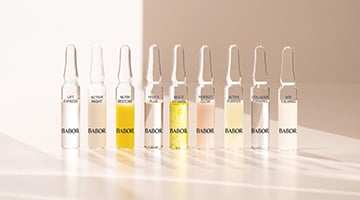
| Ampoule | A concentrated, often single-dose treatment format. The name describes presentation, not a universal ingredient specification. | Review the exact vitamin C form, formula instructions, and packaging. See BABOR ampoule formats. | Ampoule does not automatically mean stronger, more effective, or appropriate for every skin type. |
Research identifies formulation, stability, and topical delivery as connected challenges. The optimal concentration depends on the formulation, and the literature does not support treating a product category as a shortcut for judging vitamin C. Read the label, then assess the complete formula and its directions.
A Practical Checklist for Evaluating a Vitamin C Formula
A careful label review can clarify what a topical vitamin C product contains, while also showing what the packaging cannot establish. Use these questions to assess the formula without treating one ingredient or percentage as a guarantee of performance.
- Which vitamin C form is named? Look for ascorbic acid, L-ascorbic acid, or a derivative such as magnesium ascorbyl phosphate, sodium ascorbyl phosphate, or ascorbyl palmitate. These names describe different forms with different formulation characteristics. Do not assume that one is universally preferable.
- Where does the ingredient appear in the INCI list? In general, cosmetic ingredients are listed in descending order of predominance. However, ingredients present at 1 percent or less may appear in any order after those above 1 percent, so the list does not reveal an exact concentration. FDA labeling guidance explains these conventions.
- Is a percentage stated, and what does it actually describe? A disclosed number may refer to a particular form or blend, not necessarily an equivalent amount of L-ascorbic acid. The optimal concentration depends on the formulation, and concentrations above 20 percent have not been shown to add biological significance in the cited review and may increase irritation potential. Treat a larger number as context, not a ranking.
- Does the formula address stability? Ascorbic acid is sensitive to air and light, while pH, vehicle, viscosity, and physical stability can affect degradation. Examine whether the packaging limits repeated exposure and whether the directions are specific, but do not infer a product's stability from an opaque container alone.
- What evidence supports the stated benefits? Research on topical vitamin C efficacy remains limited, and one cited study found that several derivatives did not increase L-ascorbic acid levels in skin after daily use. A label can identify ingredients; it cannot prove the finished formula's efficacy, suitability, or expected visible result.
With those boundaries in mind, the topical FAQs below address the most common questions about vitamin C forms, formulation, and labels.
Find a BABOR vitamin C skincare format
Frequently Asked Questions
What is vitamin C in skincare?
Vitamin C is a topical cosmetic ingredient also known as ascorbic acid. In skincare, the term can refer to pure L-ascorbic acid or to related vitamin C derivatives used in a formula. Its cosmetic role and performance depend on the specific form and formulation.
Is L-ascorbic acid the same as a vitamin C derivative?
No. L-ascorbic acid is the direct, well-studied form of topical vitamin C, while ingredients such as magnesium ascorbyl phosphate and ascorbyl palmitate are derivatives. They differ in their chemical properties and stability, so the ingredient name matters when reading a label. A review of topical vitamin C forms explains these distinctions.
Why does vitamin C skincare need a stable formula?
Ascorbic acid is sensitive to air and light and can degrade through oxidation. Stability is influenced by several factors, including pH, concentration, vehicle, viscosity, and packaging. Therefore, the presence of vitamin C on an ingredient list does not by itself show how well a finished product will preserve the ingredient. Research on ascorbic acid stability describes these formulation variables.
Can an ingredient list show how much vitamin C a product contains?
Usually, no exact percentage can be confirmed from the ingredient list alone. Under FDA guidance, cosmetic ingredients are generally listed in descending order of predominance, while ingredients at 1 percent or less may appear in any order afterward. The formula's stated concentration, form, and supporting product information provide more context. FDA cosmetic labeling guidance explains these requirements.
Explore BABOR's Vitamin C Skincare Expertise
Understanding vitamin C forms, formulation, and packaging can make skincare labels easier to interpret. For a focused look at topical vitamin C and the formats used in skincare, explore BABOR's science-led ingredient expertise.