To tell if skincare is science-backed, look beyond scientific-sounding names and ask what evidence supports the finished product, how that evidence was gathered, and whether the claims match what was measured. Ingredient research can be useful, but it is not the same as proof that a specific formula will work for every person.
What does science-backed skincare mean?
Science-backed skincare is a useful description only when it points to evidence that is relevant to a product and its claims. That evidence may include research on an ingredient, testing of a finished formula, safety assessments, or consumer-use data. These forms of support answer different questions. Evidence that an ingredient has been studied does not by itself establish that every product containing it produces a particular result.
A careful evaluation therefore starts with three questions: What exactly is being claimed? What evidence supports that claim? Does the evidence relate to the product as sold, or only to an ingredient in general? Those questions help separate informative product detail from impressive language that does not explain its basis.
Science also has limits. Results depend on the formula, the people studied, how the product was used, the comparison group, and the outcome measured. A well-described study can strengthen confidence in a specific finding. It cannot promise an identical result for every skin type, routine, or individual.
How can you evaluate a skincare claim?
Translate the claim into something specific before assessing it. “Supports hydration,” “improves the look of fine lines,” and “helps skin feel smoother” describe different outcomes. A broad phrase such as “advanced renewal” may sound compelling, but it is difficult to evaluate unless the brand explains what it means in observable terms.
Then look for a clear connection between the claim and its evidence. Does the information name the finished product or only a featured ingredient? Does it explain the test, who took part, how long it lasted, and what was measured? Are the results described in proportion to the evidence, with limitations acknowledged? These details make it easier to judge whether a claim is precise or merely suggestive.
Be cautious when a page relies on scientific vocabulary without giving context. A complex ingredient name, a laboratory image, or a percentage can be informative, but none answers the central question by itself. The best product information makes the meaning of a claim understandable and does not ask readers to infer more than the evidence establishes.
Which kinds of evidence should you look for?
Evidence exists on a spectrum. Laboratory research can help explain how an ingredient behaves under defined conditions. It can provide a reason to study that ingredient further, but it does not directly show what a finished product will do on a person’s skin in everyday use. Research on people is more directly relevant to use, though its strength still depends on the design and reporting.
Testing a finished formula can be especially relevant because skincare products combine ingredients in a particular base and are applied in a particular way. Even then, ask what the test assessed. A safety assessment, an instrument reading, a consumer perception survey, and a controlled efficacy study are not interchangeable. Each can contribute useful information, but each supports a different kind of conclusion.
Evidence can also come from different stages of product development. Formulation rationale may explain why ingredients were selected. Stability work can address whether a product maintains specified characteristics over time. Use testing can explore how people experience a product under defined instructions. A strong explanation identifies which type of work backs which statement rather than presenting all testing as equivalent.
Look for a description of method, not just a declaration that a product was “tested.” Useful context includes the number and type of participants when applicable, the duration, the comparison or baseline, and the outcome measured. If those details are unavailable, treat the statement as limited information rather than assuming it proves a broad benefit.
What makes a study more informative?
No single label can tell you whether a study is persuasive. Consider how closely its conditions match the claim. A study should identify what was tested, how participants used it, and what the researchers set out to measure. Clear methods let readers understand the scope of the conclusion and whether it applies to the question at hand.
- Product identity: Is the tested item the same finished product being discussed, or a different formulation or isolated ingredient?
- Participants: Does the description explain who took part and whether the group is relevant to the claim?
- Duration and use: Was the product used for a stated period and according to clear instructions?
- Comparison: Was there a baseline, comparison group, or other reference point that helps interpret change?
- Outcome: Was the measured result objective, based on participant reports, or both? Does it correspond to the advertised claim?
- Transparency: Are methods and limitations described clearly enough to understand what the results can and cannot show?
A study does not become irrelevant just because it has limitations; nearly all research does. The key is whether the limitations are acknowledged and whether the language stays within the study’s boundaries. A small or short study may offer an early signal, for example, but it should not be presented as conclusive proof of a sweeping outcome.
Does ingredient research prove a finished product works?
No. Ingredient research can help explain why a formula might be worth considering, but the finished product has its own composition, texture, packaging, application directions, and use pattern. Those factors matter when interpreting how the product performs. A study on an ingredient under one set of conditions is not direct proof about every formula that includes it.
Ingredient lists are still useful. They can help you identify familiar components, check for ingredients you prefer to avoid, and compare a product’s stated purpose with its composition. But an ingredient list usually does not tell you the full concentration of each component, how ingredients interact in the formula, or whether the finished product was evaluated for a particular result.
For example, BABOR describes its Biogen Plant Extract as a combination of eight botanical actives developed through decades of research. That description explains the concept and history of an ingredient complex. It should not be mistaken for a universal promise about the outcome of every product that contains it. For another example of how ingredients are discussed in a consumer context, Harvard Health Publishing reviews science-backed skincare ingredients; ingredient-level discussion is a starting point, not a substitute for evidence about a finished formula.
When a formula highlights a technology or a particular ingredient, ask for the explanation that matters to your decision: what it is, why it is included, and what support exists for the claim being made. BABOR’s ingredient glossary and ingredient information can help clarify terminology. Read those details as educational context, not as a substitute for an assessment of your own needs.
How should you read percentages and technical terms?
A percentage can make a product description feel precise, but the number needs context. What does the percentage refer to: one ingredient, a blend, or a broader complex? Is it the amount in the finished product? What does the cited evidence say about that amount and the stated outcome? Without those answers, a number may be difficult to interpret rather than a reliable measure of performance.
Technical phrases deserve the same scrutiny. Terms such as “molecular weight,” “peptide complex,” or “encapsulation” may describe a formulation feature, but they do not automatically establish a visible result. A meaningful explanation connects the feature to the product’s intended role and explains what evidence is available. If the explanation leaps from a technical property to a guaranteed personal outcome, the claim has gone beyond what the term alone can show.
For example, BABOR describes 10D Hyaluronic Acid as using ten molecular weights. That is a formulation detail; it is not, by itself, a promise about a particular user’s results. Likewise, a stated percentage of a complex provides useful context only when you know what is included in the complex and how the percentage is defined.
Do not compare two numbers until you know they describe the same thing. A percentage of a single ingredient cannot be directly compared with a percentage of a multi-ingredient blend. Product format, instructions, and the evidence behind the claim matter too. More is not automatically better, and a larger number does not replace the need to understand the formula.
What can the product page tell you?
A detailed product page should help you understand the intended use, formula highlights, directions, and relevant cautions. Look for plain explanations rather than relying on a list of impressive terms. Check whether the product’s stated purpose fits the concern you want to address and whether the directions fit the routine you can maintain.
Separate product facts from conclusions. A page may identify ingredients, describe a texture, or explain the way a product is packaged. These facts can be valuable. A claim about a visible effect needs a separate basis. If the page says a product has been evaluated, look for an explanation of what was evaluated and what the result supports.
It also helps to read the instructions closely. Frequency, order of application, and compatibility with other steps affect how a product fits into a routine. If directions or precautions are unclear, consult the brand’s information or a qualified skincare professional instead of guessing. The BABOR digital skincare advisor is one route to product guidance, while the BABOR product overview provides a place to review available options.
Product formats can support different routine preferences without being evidence of greater efficacy. BABOR’s skincare sets and new product listings are useful for exploring the assortment. Compare the specific formula and directions, not just the format, packaging, or launch language.
How do you compare evidence at a glance?
Use the table as a reading guide, not as a rating of any specific brand. The most useful evidence depends on the claim, and several forms of evidence may contribute to a complete picture. In each case, ask what conclusion the evidence can reasonably support.
| Evidence or detail | What it can help explain | What to check | What it cannot establish alone |
|---|---|---|---|
| Ingredient research | Why a component may be relevant to a formula | Ingredient, conditions, amount, and outcome studied | That every finished product containing it produces the same result |
| Laboratory testing | How a material or formula behaves under set conditions | Test method and whether conditions reflect intended use | A particular effect on every person’s skin |
| Finished-product use testing | How the specific formula was assessed in use | Participants, duration, directions, comparison, and outcome | Results beyond the group and conditions studied |
| Consumer feedback | How participants describe their experience | Question wording, number of respondents, and test period | An objective measurement or a guaranteed individual result |
| Technical or percentage claim | A formulation feature or stated amount | Definition, denominator, and connection to the claim | That a higher number means better performance |
When comparing products, apply the same questions to each one. A consistent method prevents a dramatic claim on one page from receiving more weight than a clearly explained, narrower claim on another. It also makes it easier to notice when one product offers relevant detail and another provides only broad marketing language.
How can you distinguish evidence from marketing language?
Marketing language is not automatically false, but it is not evidence on its own. Words such as “advanced,” “powerful,” and “expert” may describe positioning rather than a measurable finding. Look for the information that follows: a defined claim, a specific formula, a test description, or an explanation of the ingredient’s role.
Watch for claims that combine several ideas in one sentence. A product might be described as supporting hydration, radiance, firmness, and smoother-looking skin. Ask whether each outcome was assessed and whether the page distinguishes user impressions from measured findings. If one study is used to support a list of very different benefits, see whether its actual outcomes cover that full list.
Be alert to absolute language. Statements implying that a product works for everyone, delivers instant change, or guarantees a lasting outcome need unusually strong support. Individual experience varies, and skincare routines involve many factors. A credible explanation sets expectations carefully and tells you what the evidence does not answer.
When information is incomplete, you do not need to assume the product is ineffective. Instead, mark the unanswered question and decide whether you have enough information to make a considered choice. You can also seek clarification from the brand or a qualified professional. This approach is more useful than treating either persuasive phrasing or scientific terminology as a verdict.
How does skin compatibility fit into the evidence?
Evidence about a product and its fit for you are related but separate questions. A formula may be supported for a stated purpose and still not suit your preferences, sensitivities, or routine. Consider your current products, application habits, and any advice you have received from a healthcare professional.
Introduce changes thoughtfully. Follow the product directions, avoid adding several unfamiliar products at once when you are trying to understand your skin’s response, and pay attention to discomfort. If you have a known sensitivity or a skin condition, seek advice from an appropriately qualified professional about whether a product is suitable for you. Product information is not a diagnosis or personalized medical advice.
Routine consistency also matters when you are assessing your experience. If you change multiple steps at the same time, it becomes harder to understand which change is associated with what you notice. Keep expectations realistic and give yourself a clear way to observe comfort, texture, and the outcomes that matter to you, while remembering that personal observation is not the same as a controlled study.
What practical checklist can you use before choosing?
Before adding a product, take a few minutes to work through this checklist. It keeps the decision focused on the formula, evidence, and your routine rather than on a single headline claim.
- Name the goal. Write down the specific concern or routine need you want the product to address.
- Make the claim concrete. Identify the result the brand says to expect and whether it is clearly defined.
- Find the evidence. Check whether support concerns the finished formula, an ingredient, or a general formulation concept.
- Read the method. Look for what was assessed, how long it took, who participated, and how the result was measured.
- Check the boundaries. Notice whether the claim is limited to the conditions studied or presented as universal.
- Review directions and cautions. Confirm how the product is intended to fit into your routine.
- Consider your own needs. Account for preferences, sensitivities, and professional guidance relevant to you.
- Compare consistently. Use the same questions for each option and avoid treating a higher percentage or more elaborate phrase as proof.
If you want to browse products while applying these questions, start with BABOR’s bestsellers or explore the BABOR skincare stories for additional educational content. The product page and its instructions should remain your source for product-specific details.
How does BABOR fit into an evidence-led approach?
BABOR’s background combines professional skincare expertise with research and product development in Germany. For shoppers, the practical task is still to assess each product on its own terms: identify its intended use, review its formula information, read its directions, and look for support that matches the claim you are considering. A brand’s heritage can provide context, but it does not replace product-specific evaluation.
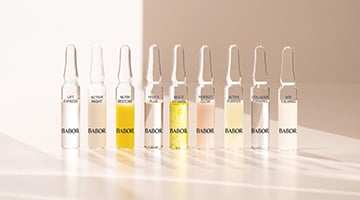
BABOR’s portfolio includes different product formats and lines, including Ampoule Concentrates described as seven-day treatments. Format and duration can help you decide how a product might fit your routine; they do not alone establish a particular outcome. Review the details for the individual product and choose based on the evidence and directions provided.
For additional context on the BABOR assortment, use the retailer finder to locate a retailer, or review the relevant product information online. If you need help navigating options, the skincare advisor offers a starting point for product guidance. Keep the distinction clear: educational information can help you ask better questions, while the right choice depends on the evidence, your needs, and the product’s instructions.
Explore the BABOR skincare advisor
Frequently asked questions
Does a scientific-sounding ingredient name prove a product is effective?
No. A name tells you what an ingredient or technology is called, not whether a finished formula has been shown to support a specific claim. Look for the product’s evidence and the method behind it.
Is ingredient research still useful when it is not product testing?
Yes. It can explain why an ingredient is included and what researchers have investigated. Interpret it as ingredient-level context, then check whether the product claim has relevant support of its own.
What should I do if a brand says a product was tested but gives few details?
Treat the statement as limited information. Look for the kind of test, what was measured, the conditions, and the results. If those details are not provided, avoid assuming that the statement proves a broad benefit.
Does a higher ingredient percentage mean a product is better?
Not by itself. First establish what the percentage represents and whether it can be compared with another product’s figure. Formula context, directions, relevant evidence, and your own needs all matter.
Can research guarantee how my skin will respond?
No study can guarantee an identical personal response for everyone. Research can inform a decision and help set expectations, while individual experience varies. Follow directions and seek qualified advice if you have specific concerns.
Science-backed skincare is best judged through clear claims, relevant evidence, and honest limits. Use those principles to compare products thoughtfully and choose a formula that makes sense for your routine.