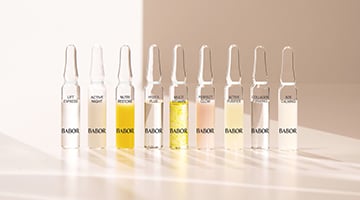
If you are comparing the best serum for open pores and dull skin, start by separating two concerns that can look related but may need different routine priorities. A serum may support a smoother-looking, more hydrated, or more radiant complexion, but it cannot make pores disappear. The most useful choice is the formula that addresses your main concern, suits your skin’s tolerance, and fits a routine you can follow consistently.
Find a BABOR skincare routine for your goals
What should the best serum for open pores and dull skin do?
Short answer: Look for a serum that prioritizes either hydration and a smoother surface, or radiance and more even-looking tone, depending on what you notice most. Pores are a normal feature of skin, and their appearance can vary with skin characteristics, oil, and the way light reflects from the surface. A topical formula can support the look and feel of skin; it cannot permanently close pores or guarantee a particular result.
“Open pores” is a common way to describe pores that seem more visible. They are not doors that open and close. Their visibility can be influenced by factors such as skin type, oiliness, congestion, texture, and changes in the surrounding skin. Dullness is also a description rather than one diagnosis. It may refer to a lack of glow, uneven-looking tone, dryness, or rough-feeling texture. Because the terms cover several different observations, choosing a serum by label alone can be misleading.
Instead, identify the change you would most like to see. Does your skin feel tight or look less supple? Does the surface feel uneven? Or is the primary concern that your complexion looks flat? Then select one main formulation priority. That gives you a clearer starting point than layering several concentrated products at once.
Why can pores look more visible and skin look dull?
Pores are part of normal skin. Their visible appearance differs from person to person and can change with the skin’s surface and surrounding tissue. A serum can alter the feel and appearance of the skin temporarily through hydration or other cosmetic effects, but claims that a product permanently shrinks or closes pores should be treated cautiously.
Dullness can also have more than one source. When skin feels dry or rough, light may not reflect as evenly from its surface. Uneven-looking tone can make the complexion appear less radiant, while excess layers or residue may affect how skin feels. These observations do not establish a medical cause, and a skincare routine should not be expected to diagnose one.
This distinction helps set sensible expectations. Hydration-focused formulas may make skin feel more comfortable and look more supple. Exfoliating ingredients can help refine the feel of the surface when used appropriately. Antioxidant-focused products are often selected as part of a routine aimed at radiance. None of these categories guarantees that visible pores will vanish or that every kind of dullness will respond in the same way.
Which serum ingredient profile fits your main concern?
Think in terms of a formula’s overall role, not a single trending ingredient. The product’s base, concentration, accompanying ingredients, and your routine all affect the experience. A product page or ingredient list can help you compare options, but a long list of actives is not automatically a better match.
| Skin observation | Formula direction to consider | What it may support | How to choose with care |
|---|---|---|---|
| Skin feels tight or looks less supple | Hydration-focused serum, including humectant ingredients | A more comfortable, hydrated feel and a supple-looking surface | Consider how the serum layers with moisturizer; do not assume hydration alone will change pore size. |
| Surface feels rough or looks uneven | Gently exfoliating or refining formula | A smoother-feeling surface when the product is suitable and used as directed | Introduce one exfoliating product at a time and avoid combining multiple strong steps at the outset. |
| Complexion looks flat or lacks radiance | Radiance-oriented formula, such as one featuring antioxidant ingredients | A brighter-looking appearance as part of a consistent routine | Review directions and compatibility; allow time to assess one change before adding another. |
| Several concerns compete for attention | A simple, well-tolerated serum matched to the first priority | A more manageable routine and clearer way to evaluate fit | Start with one product, track comfort and appearance, and adjust gradually. |
Hydration is a sensible first consideration when discomfort or a less supple look is prominent. Hyaluronic acid is one familiar hydration-oriented ingredient, but the whole formula and the way it feels on your skin matter more than an ingredient name on its own. BABOR’s formulation portfolio includes a 10D Hyaluronic Acid system described as using multiple molecular weights; that is a formulation detail, not a promise that one serum is right for every person.
If uneven texture is the priority, look closely at exfoliating products and follow their directions. More frequent or more intensive use is not automatically better. If radiance is the focus, consider the full formula and how it fits alongside the rest of your routine. BABOR’s portfolio includes peptide and botanical formulation technologies; these describe product approaches and should not be read as a guarantee of a specific cosmetic result.
Use the BABOR ingredient glossary and ingredient information as starting points when you want to understand terminology. Ingredient explanations can make comparison easier, but they do not replace the product’s use instructions or an individual assessment of tolerance.
How can you compare serum options without overcomplicating your routine?
Before adding a product, write down your primary concern in plain language. For example: “My skin feels tight by midday,” “my skin texture looks uneven,” or “my complexion looks flat.” A specific observation helps you evaluate whether a formula’s stated role makes sense. It also keeps you from expecting one product to solve unrelated concerns at once.
- Choose a single priority. Decide whether hydration, surface refinement, or radiance is the most important starting point. If you are unsure, begin with the concern that affects comfort or routine consistency.
- Read directions and product details. Check when and how the serum is intended to be applied, which other steps it is designed to complement, and any cautions on the product page. Do not infer a product’s strength or suitability from a marketing phrase alone.
- Consider texture and layering. A serum should fit comfortably beneath the moisturizer and other steps you already use. If it pills, feels heavy, or makes the routine cumbersome, it may be difficult to use consistently even if its ingredient profile sounds appealing.
- Make one change at a time. Introducing several new products together makes it harder to tell which one is working well for you—or which one is not a good fit. Follow each product’s instructions and give yourself a clear way to assess it.
- Keep expectations realistic. Track comfort, smoothness, and the look of radiance rather than expecting pores to disappear. If a concern is persistent, uncomfortable, or worsening, consider seeking advice from a qualified skincare professional or health professional.
For a broader view of available options, browse BABOR’s product selection or current bestsellers. A bestseller is a discovery route, not proof that the formula is the best match for your particular skin goals.
What product details are worth comparing?
When you compare product pages, look past the headline claim and read the practical details. Check the intended use, the application directions, and whether the product is presented as a standalone step or as part of a routine. These details help you understand where the serum may fit, without assuming that a product’s name or featured ingredient predicts your personal result.
Next, consider the formula’s sensory profile. A lightweight texture may suit someone who prefers minimal layering, while another person may prefer a richer feel. Neither texture is inherently better. The right choice is one that sits comfortably with your moisturizer and other steps, and that you are likely to use as directed. If you already use an exfoliating product, review the directions before adding another exfoliating step.
Check the full ingredient information if you know that you are sensitive to a particular ingredient. An ingredient list can support an informed comparison, but it does not predict every individual response. If you have a known allergy or a history of reactions, a qualified professional can help you decide what precautions make sense.
Finally, decide what you will use to assess the product. Choose one or two observations, such as how comfortable your skin feels or whether its surface looks more radiant to you. Keep other routine steps stable while you evaluate the new serum. This simple approach makes the decision process more useful than switching products based on every new trend.
How to read a serum label in context
Ingredient lists are useful for checking whether a formula contains an ingredient you recognize or need to avoid, but they do not tell the whole story. The list does not show how a serum will feel after it dries, whether it will layer smoothly under your moisturizer, or how your skin will respond. Look at the product’s stated purpose and instructions alongside its ingredient information. If the page describes a serum as a hydration step, for example, compare it with your hydration priority rather than assuming it will also address texture or tone.
When a formula highlights several actives, ask whether each one is relevant to your primary concern and whether you already use a similar step. A routine with multiple products aimed at the same goal may add complexity without making your decision clearer. Conversely, a simpler formula that feels comfortable and fits your existing routine may be easier to use consistently. These are practical comparison points, not a ranking of one ingredient family over another.
Explore BABOR’s skincare selection
How should you add a serum to your routine?
Apply products in the order directed on their packaging. A straightforward routine is often easier to assess than a long sequence of treatments. In general, start with cleansing, apply the serum as directed, and follow with the moisturizer and daytime protection that suit your routine. Keep the product’s own instructions as the authority for amount, timing, and frequency.
Introduce a new serum gradually, especially when it contains exfoliating ingredients or when your routine already includes other active products. Avoid beginning multiple unfamiliar products at once. If your skin becomes uncomfortable, stop using the product and review its directions. A patch test may be useful for some people, but it cannot guarantee that a product will not cause a reaction when used more broadly.
Daytime sun protection is an important routine consideration, particularly when using products that may increase sensitivity to the sun. Follow the product directions and choose protection appropriate for your needs. If you have a skin condition, a history of reactions, or questions about combining ingredients, ask a qualified professional for individual guidance rather than relying on a generic routine.
Consistency matters, but there is no universal timeline that guarantees visible change. Keep notes on how the product feels and how your skin looks under similar lighting. Review the routine after you have used the serum as directed for a reasonable period. If the texture or sensory experience makes you skip it, a simpler or more comfortable option may be more practical.
A simple way to track your first few weeks
Before you begin, note your starting point in a few neutral words: tightness, surface feel, or overall radiance. Keep your other routine steps steady, then record whether the serum feels comfortable and how it layers on the days you use it. Similar lighting and a similar time of day can make visual comparisons less confusing. The purpose is not to create a clinical measurement or expect a scheduled result. It is to notice whether the formula fits your routine and whether the change you wanted to assess seems relevant.
If you change several steps, use the serum differently from its directions, or alternate products unpredictably, it becomes harder to interpret what you notice. Go back to the product instructions and simplify the routine if needed. If discomfort develops, stop and seek appropriate advice rather than pushing through simply to complete a trial period.
When should you choose professional guidance?
Online product descriptions can help narrow down a category, but they cannot assess your skin in person. A skincare specialist can help you talk through concerns, routine steps, and product fit. BABOR offers a digital skincare advisor for exploring a routine, and you can use the BABOR retailer finder to look for a retailer. Product availability and the advice offered may vary by location.
Seek advice from a qualified health professional for persistent irritation, sudden changes, or concerns that feel beyond cosmetic routine selection. A serum is a cosmetic product, not a substitute for diagnosis or medical care. For general skin-care education, consult the American Academy of Dermatology Association; its information is not a substitute for individualized medical advice. This is especially important if a product causes ongoing discomfort or if you are unsure whether an ingredient is suitable for you.
Explore a personalized BABOR skincare routine
Frequently asked questions
Can a serum close or permanently shrink pores?
No. Pores are a normal feature of skin, and a serum cannot make them disappear. A formula may support a smoother-looking or more hydrated surface, which can affect how skin appears, but avoid promises of permanent pore closure.
Should I choose hydration or exfoliation first?
Let your main observation guide the first step. If your skin feels tight or less supple, a hydration-focused formula may be the more relevant place to start. If uneven texture is the main concern, consider a refining product and follow its instructions carefully. Add one new product at a time.
Can I use more than one serum for pores and dullness?
Some routines include more than one serum, but adding several products at once can make a routine harder to evaluate and may not be necessary. Begin with one product matched to your priority, check the directions, and consider compatibility with your existing steps before combining formulas.
How long should I use a serum before judging it?
There is no single timeline that applies to every formula or person. Follow the product directions and assess comfort and appearance consistently rather than expecting an immediate or guaranteed result. Stop if the product causes ongoing discomfort and seek professional guidance when appropriate.
How do you choose the right next step?
The best serum for open pores and dull skin is not necessarily the strongest or most popular option. It is the formula whose role matches your main concern, whose texture fits your routine, and whose directions you can follow comfortably. Start with one clear priority, keep the rest of your routine manageable, and choose products for realistic cosmetic goals—not promises to erase normal skin features.


