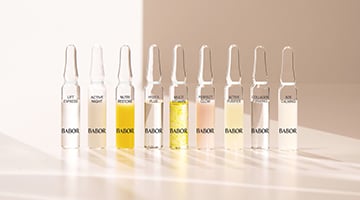
Skincare products work best as a considered sequence, not as a collection of unrelated steps. Start with cleansing, choose a serum for a defined routine priority, add moisturizer for comfort, and reserve targeted treatments for a clear purpose. Let texture, directions, and your skin's response guide the final regimen.
Explore BABOR's skincare advisor
What is the simplest way to organize skincare products?
Think in terms of a routine's job at each step. First, remove the day's residue with a suitable cleansing product. Next, apply a serum or other leave-on formula when it serves a specific priority. Follow with moisturizer if your skin benefits from it. In the morning, finish with a sunscreen product whose label and directions suit your use. Targeted treatments can be added when their directions fit the routine, rather than simply because another step is available.
This order is a framework, not a rule that every person needs every category. Some routines are deliberately brief. Others include a carefully selected treatment. The useful question is not "How many products can I add?" but "What purpose does each product serve, and can I use it consistently as directed?"
What does each routine step do?
Product categories are easiest to compare when their role is clear. The same category can include different textures and directions, so the label matters as much as the name on the package. Use this overview to identify a step before deciding which formula belongs there.
| Routine step | Product role | What to compare | Practical check |
|---|---|---|---|
| Cleansing | Removes surface residue as part of preparing skin for leave-on products. | Texture, directions, and whether it is intended for the face and your cleansing routine. | Does it fit the time of day and leave skin feeling comfortable? |
| Serum | Adds a focused leave-on step when a formula's stated purpose fits your priority. | Directions, texture, placement, and ingredients listed for the product. | Can you use it in the intended order without piling on overlapping steps? |
| Moisturizer | Provides a moisturizing step with a texture selected for personal comfort. | Richness, finish, directions, and how it layers with other products. | Does the finish feel appropriate for day or night? |
| Targeted treatment | Addresses a particular routine goal according to its specific instructions. | Frequency, placement, cautions, and whether it fits with the rest of the regimen. | Are the directions clear, and can you introduce it without changing several steps at once? |
| Sun protection | A daytime protection step when the selected product is labeled for that use. | Label, directions, intended use, and how it fits the day's routine. | Can you follow the product directions consistently? |
The table is a decision aid, not a claim that all products in one category behave identically. Product directions take priority over a generalized routine order. When reviewing a label, separate the product's role from its presentation. Look for directions that tell you where and when to apply it, how much to use, and how often. Read cautions and storage details as well. If the information is unclear, do not fill in the gaps with assumptions based on another product in the same category. Seek clarification from the brand or a qualified professional when the directions affect how you would use the product. It also helps to distinguish a routine need from a preference. A product might be appealing because of its texture or packaging, but those features do not explain where it fits. Write down the step you want it to perform before comparing options. If you cannot identify a distinct purpose, pause before adding it. This simple test keeps the routine coherent and makes it easier to assess whether each step earns its place. For U.S. context when checking cosmetic product information, consult the U.S. Food and Drug Administration and its official resources.
How do you choose a cleansing product?
Begin with the circumstances of use. A morning cleansing step may be different from the one you prefer after wearing makeup or sunscreen. Consider whether you want a balm, cream, gel, or another texture, then read the directions to confirm how the product is meant to be applied and removed. Sensory preference matters: a product that feels pleasant and fits the time you have is more likely to become a steady part of your routine.
Notice your skin's response after use rather than judging a product by one feature on the front label. If your face feels uncomfortable, tight, or otherwise unlike its usual state, reconsider the product or how you are using it. Avoid changing several products at once; otherwise it becomes difficult to tell which change affected the experience. If you have persistent discomfort or a skin concern that needs individualized guidance, ask a qualified health professional rather than trying to solve it by adding more products.
Compare category descriptions and directions before browsing individual options. BABOR's skincare product selection provides a starting point for exploring the range. Choose a product by its stated role and instructions, not just a texture name or a single highlighted ingredient.
What should guide your serum choice?
A serum is a leave-on step; it does not need to be present in every routine. Select one only after identifying what you want that step to contribute. Translate a broad wish such as "more comfortable" or "more even-looking" into a practical criterion: texture, intended use, ingredients, or where the product fits. Then compare the product's directions with the rest of your routine.
Read the whole product description and label. Pay attention to the intended application area, amount, timing, and any cautions or pairing instructions. Do not assume that a concentrated-feeling texture means a product should be used more often, or that two formulas with a shared ingredient have the same purpose. The formula and its directions are the basis for use. Make the comparison concrete by writing down two or three criteria before browsing: the role you want, a texture you are comfortable using, and any directions that matter to your schedule. Then compare products against those same criteria. A short list prevents one attractive feature from dominating the decision and gives you a clear reason for choosing a particular step.
When comparing serums, ask whether the step is distinct from what you already use. If two products seem to serve the same purpose, decide whether both are truly needed before adding them together. Fewer, well-understood steps can make it easier to observe how your skin responds and to follow the routine consistently. Explore BABOR's featured skincare products as one way to see current offerings, then check each item's details rather than treating a collection page as a substitute for directions.
How do you match a moisturizer to the rest of a routine?
Choose a moisturizer by the feel you want and by how it layers with the products around it. A lighter texture may be more comfortable for one person or time of day; another person may prefer a richer finish. These are preferences to assess, not universal rules about skin type. Consider whether the product sits comfortably over your serum and under any daytime product you use.
Apply according to the product's directions and give the routine a little time before making several adjustments. Notice whether the texture feels comfortable, whether it fits the season and environment, and whether the layering is easy to repeat. A moisturizer need not be chosen solely by age, a trend, or an ingredient headline. Your own comfort and the formula's stated role are more useful decision points. One practical comparison is to test the same amount of attention on each option: note the texture, the directions, and how it feels alongside the products already in use. Avoid assuming that a richer texture is always better for nighttime or that a lighter texture is always right for daytime. The right choice is the one that fits your preferences and product instructions.
Consider the conditions in which you will use it. A formula that feels comfortable in a cool, dry room may feel different in warm or humid weather. You can adjust a routine as your preferences change, but make one change at a time and continue to follow the product's directions. There is no need to keep a step that feels unpleasant or makes the regimen difficult to repeat.
If you are reviewing your steps together, BABOR's skincare sets can help you view products presented as a group. Check what is included and read each product's individual directions; a set does not mean every item is necessary for every routine.
When should you add a targeted treatment?
Add a treatment when you can name its purpose and understand its directions. "Targeted" does not mean that more frequent use is better, nor does a treatment automatically belong in every morning and evening routine. The label should clarify how and when to apply it. Follow its cautions, and avoid combining products in a way the directions advise against.
Introduce one new step at a time. Keep the rest of the routine familiar while you learn how the new product feels in use. Note the date you began, the frequency stated in the directions, and any changes you make. This simple record helps you distinguish a product's effect from changes in weather, schedule, or other routine steps. Stop use if a product causes a concerning reaction, and seek appropriate professional advice when needed.
For products with specific precautions or directions that are unclear, do not rely on a generalized online sequence to settle the question. Check the product information or ask a qualified professional. BABOR's ingredient glossary can support ingredient-term reading, but it does not replace the directions for an individual product or personalized health advice.
How should you place products in a morning and evening routine?
A useful routine is one you can repeat without uncertainty. In the morning, use the cleansing step that fits your preference, follow with a chosen leave-on product if needed, moisturize if that step suits you, and use a daytime sun protection product according to its label. Keep the order and number of steps manageable enough to follow on an ordinary day.
In the evening, remove the day's residue with a product suited to that purpose, then use a serum or treatment only if its directions fit the time and the rest of your routine. Finish with moisturizer if desired. Product-specific directions may call for a different placement or frequency, so the routine outline should never overrule them.
When multiple leave-on products are involved, consult their directions rather than assuming that all can be layered in any order. If their instructions conflict or the combination is uncertain, simplify the routine until you can get product-specific guidance. This is especially useful when adding a new treatment: keep familiar steps stable and avoid introducing multiple unfamiliar formulas together.
How can you compare products without overcomplicating the choice?
Use a short comparison process instead of judging a product by packaging or one prominent claim. First, identify its category and intended role. Second, check the application directions and frequency. Third, assess whether the texture fits your preference and current routine. Finally, decide what you will observe after using it as directed. These four checks can narrow a broad choice without turning your regimen into a long checklist.
- Role: What specific step or priority would this product address?
- Directions: What amount, timing, and frequency does the product specify?
- Compatibility: Does it fit the products you already use, including any stated cautions?
- Experience: Is the texture comfortable and practical for your daily routine?
- Evaluation: Can you give the product a fair, consistent try without changing several other steps?
Keep expectations measured. A skincare product is one part of a personal routine, and individual experiences vary. A label or category name is not a promise of a particular outcome. If the goal involves a persistent or significant skin concern, speak with a qualified health professional about appropriate guidance.
Get guidance for exploring BABOR skincare
How do you build a complete regimen one step at a time?
Start with the routine you already follow. Write down each product, when you use it, and what role you believe it serves. Mark any step whose purpose or directions are unclear. This inventory helps distinguish a genuine gap from the feeling that a routine needs another product. It also gives you a practical reference if you seek professional advice.
- Set the foundation. Choose a cleansing step that fits your schedule and leaves you comfortable.
- Define one priority. Decide whether a serum or targeted treatment has a distinct role in your routine.
- Choose a moisturizing step. Select a texture you enjoy and can layer as directed.
- Complete the daytime routine. Include a sun protection product labeled for that use and follow its directions.
- Review the sequence. Check every product's instructions and remove steps that duplicate a purpose or make the routine hard to sustain.
- Observe before adjusting. Add or change one product at a time, then pay attention to comfort and practicality.
For help finding a place to explore the brand in person, use BABOR's retailer search. A conversation can help you clarify texture preferences and product directions. Share what you already use so that any discussion starts from your actual routine rather than an imagined blank slate.
Frequently asked questions
Do you need a serum in every skincare routine?
No. A serum is an optional leave-on step. Include one when its stated role and directions fit a specific priority and the rest of your regimen. A shorter routine can still be thoughtfully organized.
Should moisturizer go before or after serum?
In a general routine framework, serum commonly precedes moisturizer, but follow the specific product directions. Texture alone does not determine the correct order, and instructions may vary by formula.
Can you introduce several new products at once?
It is usually more informative to introduce one new product at a time while keeping the other steps stable. That makes it easier to notice how your skin responds and to identify which change may be relevant.
How do you decide whether a product belongs in the routine?
Identify its role, read its directions, and consider whether it adds a distinct step you can use consistently. If its purpose is unclear or its instructions conflict with another product, pause and seek product-specific guidance.
Explore skincare products with BABOR's advisor
A complete regimen is not defined by the number of products it contains, but by clear roles, considered choices, and steps that fit comfortably into daily life.


