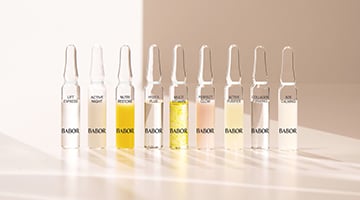
What is a cosmeceutical? It is an informal industry and marketing term for a cosmetic product presented as offering targeted skin benefits. U.S. law does not define it as a separate product category. Intended use, ingredients, and claims, not the label alone, matter when considering what a product is and what it may do.
Explore BABOR skincare products
What is a cosmeceutical, in practical terms?
People use the word cosmeceutical to describe skincare positioned between conventional cosmetics and medicines. The idea is that the product combines a cosmetic purpose, such as washing, moisturizing, or improving the look of skin, with ingredients associated with a targeted benefit. The term can be useful shorthand in beauty conversations, but it does not tell you exactly what a product does or how much evidence supports its claims.
The U.S. Food and Drug Administration (FDA) states that “cosmeceutical” has no meaning under the law. Under the Federal Food, Drug, and Cosmetic Act, products may be cosmetics, drugs, or both. Their intended use is a key factor in determining how they are regulated. A product intended to wash or beautify may be a cosmetic; a product intended to treat or prevent disease, or affect the structure or function of the body, may meet the definition of a drug. Some products can fall into both categories. Read the FDA’s explanation of the cosmeceutical term for its regulatory context.
That distinction matters when you shop. A polished label, a familiar active ingredient, or a phrase such as “science-inspired” does not by itself establish a product’s legal status, effectiveness, or suitability for your skin.
Instead, consider the product’s stated purpose, complete ingredient list, evidence for the specific claim, directions, and how it fits into your routine.
Why does the term need careful interpretation?
Cosmeceutical is a blend of “cosmetic” and “pharmaceutical.” In professional and consumer settings, people often use it for cosmetic products containing biologically active ingredients or for formulas marketed with more targeted skin benefits.
But the word is not a regulatory shortcut. It does not certify a product, guarantee a particular concentration, or demonstrate that independent studies have confirmed every claim.
Scientific literature also uses the term as a descriptive concept. A review available through the National Library of Medicine discusses cosmeceuticals as products at the intersection of cosmetics and pharmaceuticals, while recognizing the category’s lack of a simple, universally accepted definition. This context can help explain why the term appears in articles and product discussions, but it should not be mistaken for a government approval category. See the NCBI Bookshelf overview of cosmeceuticals.
A separate review in the biomedical literature likewise discusses the way the term is used for products positioned between cosmetics and pharmaceuticals. These academic descriptions explain a convention in skincare discussions; they do not create a legal status or certify individual products. The review of cosmeceuticals in the biomedical literature is useful background for readers who want to see how the concept is discussed in research.
For a shopper, the practical takeaway is straightforward: evaluate the product and its claims, not just the label.
Ask what result is being promised, whether that result is cosmetic or therapeutic in nature, what evidence is offered, and whether the directions and warnings are clear.
If a claim suggests treatment of a medical condition, seek advice from an appropriate health professional rather than relying on a marketing term.
How are cosmetics, drugs, and cosmeceuticals different?
The words can overlap in everyday conversation, but they do not mean the same thing in U.S. regulation. The comparison below is a starting point, not a classification of any particular product.
A product’s intended use and claims matter, and the FDA’s own guidance should be consulted when regulatory questions arise.
| Term | How it is generally used | What the term establishes | What to check as a shopper |
|---|---|---|---|
| Cosmetic | A product intended to wash, beautify, promote attractiveness, or alter appearance. | A recognized legal category when the product meets the applicable definition; the label alone does not establish every detail. | Intended use, directions, ingredients, warnings, and support for specific appearance claims. |
| Drug | A product intended to diagnose, cure, mitigate, treat, or prevent disease, or to affect the body’s structure or function. | A recognized legal category with applicable regulatory requirements. | The intended use, claims, directions, and relevant regulatory information; ask a qualified health professional about treatment questions. |
| Cosmetic and drug | A product may serve cosmetic purposes and also be intended for a drug use. | Some products can meet both definitions, depending on their use and claims. | Read the full label and instructions; do not assume cosmetic positioning excludes drug requirements. |
| Cosmeceutical | An industry or marketing term for a cosmetic associated with targeted or active-ingredient benefits. | No separate product category or status under U.S. law. | Look past the word and assess specific claims, evidence, ingredients, and routine fit. |
The table is deliberately broad. It is not a legal determination for a specific product. The FDA notes that a product’s intended use can be established through claims made in labeling, advertising, and other circumstances.
When a product claim appears to promise treatment or a physiological effect, do not infer that its cosmeceutical label settles how it is regulated.
Which ingredients are associated with cosmeceutical products?
There is no official ingredient list that makes a formula a cosmeceutical. The term may be applied to products featuring ingredients studied for their effects on the appearance or feel of skin.
Common examples in skincare discussions include retinoids, peptides, antioxidants, exfoliating acids, niacinamide, and forms of hyaluronic acid.
Their presence does not by itself establish a specific result, prove a product’s performance, or indicate that every person should use it.
Ingredient names also need context. Different forms, concentrations, combinations, vehicles, and directions can affect how a formula is designed and experienced.
A study about one ingredient or one test formula does not automatically prove that every product containing that ingredient will deliver the same outcome. The finished product, the way it is used, and the particular claim all matter.
For example, a product page may feature a peptide or antioxidant. That can tell you something about the formula’s focus, but it does not answer every useful question: What is the product intended to do? What evidence supports that stated benefit? How should it be applied? Does it suit the rest of your routine? BABOR’s ingredient glossary can help you look up ingredient terminology, while the label and product directions remain essential when assessing a particular formula.
Be cautious with broad statements such as “clinically proven” or “dermatologically tested” when they appear without details. Ask what was tested, how the result was measured, and whether the available evidence relates to the finished product or only to an ingredient.
No single phrase can replace the context needed to evaluate a claim.
How can you evaluate evidence behind a skincare claim?
Start with the exact promise. “Helps skin look smoother” is an appearance claim; “treats a skin disease” is a medical claim. The wording, context, and intended use can affect how a claim is understood.
Avoid treating vague phrases such as “advanced,” “professional,” or “active” as evidence. Look for a clear description of the result and a proportionate explanation of the support behind it.
Then ask what kind of evidence is being presented. Ingredient research can help explain why an ingredient is being used, but it may not establish that a particular finished product performs as claimed.
A product-specific study is more directly relevant to a finished formula, yet it is still worth understanding what was measured and under what conditions.
If a brand describes testing, useful context includes who participated, how long the test lasted, what outcome was assessed, and whether the findings match the claim being made.
- Match evidence to the claim. A study of hydration does not demonstrate wrinkle reduction, and an ingredient study is not necessarily a trial of the product you are considering.
- Look for specifics. Clear descriptions of test methods and outcomes are more informative than a broad statement that a formula is “tested.”
- Consider limitations. A short test, a small group, or a subjective assessment may provide useful information, but it may not answer every question about long-term use or different skin types.
- Separate appearance from treatment. A cosmetic benefit and a medical outcome are not interchangeable. For treatment concerns, speak with a qualified health professional.
It can help to examine a claim in a fixed order rather than judging it by the strength of its language. Use this four-step process:
- Define the promise. Write down the outcome being promised in plain terms.
- Identify the evidence subject. Check whether the support refers to an ingredient, the finished formula, or the general category.
- Check the measurement. Confirm whether the method actually measured the stated outcome.
- Compare the conditions. Review the directions and the conditions in which the product was assessed. If one of these links is missing, ask for more information before treating the claim as meaningful.
For instance, imagine two product descriptions that both mention an antioxidant. One says the ingredient is included in the formula; the other describes a product-specific assessment of a stated appearance benefit.
The second provides a closer connection between the finished formula and the claim, though you would still want to know what was assessed, over what period, and how the outcome was recorded.
Ingredient presence alone answers a formulation question, not necessarily a performance question.
When evidence descriptions are vague, use questions that invite concrete answers: Was the finished product assessed or only one ingredient? What outcome did participants or researchers evaluate? Were directions consistent with normal use?
Does the stated result match the promise on the label? You do not need to conduct a scientific review to be a careful shopper; these questions simply help distinguish useful product information from broad language that leaves the claim unclear.
Evidence is one part of a decision, not the whole decision. A well-supported claim does not guarantee that a formula will suit every person. Consider your skin’s needs, sensitivities, other products, and the directions for use.
If you are unsure about a new active ingredient or have a persistent skin concern, a dermatologist can offer individualized guidance.
How do you choose a product that fits your routine?
Begin with the role you need a product to play. Is the goal to wash, moisturize, support a more even-looking complexion, or add a targeted treatment step? A clear purpose makes it easier to compare products without being distracted by category language.
Next, consider format and how it will sit alongside the products you already use.
- Name the routine need. Choose one priority at a time, such as hydration or an appearance-focused treatment step. A product with several advertised benefits may not be the best fit if its main purpose is unclear to you.
- Read the full ingredient list and directions. Check for ingredients you already know you do not tolerate, and note how frequently the product is meant to be used. Follow the label rather than assuming a stronger or more frequent application is better.
- Introduce one change at a time. This makes it easier to notice how your skin responds. Follow product directions and discontinue use if you experience an unwanted reaction. Seek medical guidance for significant or persistent symptoms.
- Think about format. A serum, cream, face wash, or concentrated treatment serves a different routine role. Texture and application preferences can affect whether a product is practical for consistent use.
- Review the value of the whole routine. Consider whether the product fills a genuine gap, whether you can follow its directions, and whether you already use products with overlapping purposes.
For instance, someone seeking a straightforward moisturizing step may prioritize texture, comfort, and compatibility with other products.
Someone considering an exfoliating product may pay closer attention to the instructions and how it fits with existing active ingredients. Those are different shopping questions, even if both products are described with the same broad cosmeceutical label.
It is also useful to think through the routine in sequence. List the products you already use, note their stated purposes, and identify any step that feels redundant or difficult to follow. Then compare a potential addition by its directions, texture, and intended role.
This is not about adding as many targeted formulas as possible. It is about choosing a product you can use as directed and that has a clear place in your routine.
As a practical example, suppose you are considering a serum because its description features an active ingredient.
Before deciding, check whether it is intended for a daily or occasional step, what other products the directions mention, and whether you already use a formula serving that role.
If the information is unclear, ask a qualified skincare professional or contact the brand for product details instead of guessing how to combine products.
A consultation can also help translate a general concern into a manageable routine. BABOR provides a skincare advisor service for exploring product recommendations. You can also browse the BABOR bestsellers or review skincare sets as ways to understand available formats and routines. Product availability and suitability depend on your needs, so review each product’s details rather than inferring benefits from the collection name.
What does the term mean for professional skincare?
In a spa or professional beauty setting, the term may help describe products positioned around targeted ingredients and a more considered routine. It still does not replace product-specific information or professional judgment.
A practitioner can explain the intended role of a product, how it fits into a service or home routine, and which directions to follow.
That discussion should stay within the practitioner’s qualifications and should not turn a cosmetic claim into a diagnosis or treatment promise.
For beauty professionals, precise language helps clients make informed choices. Explain what a product is designed to do in cosmetic terms, point to its directions and ingredients, and distinguish an appearance benefit from a medical claim.
If a client describes a persistent or worsening skin condition, refer them to an appropriate healthcare professional rather than relying on a cosmetic product to address it.
Consumers can use the same disciplined approach when considering professional skincare at home. Ask whether the product is intended for daily use or a specific step, whether it is suitable for your routine, and what the product information actually supports.
A professional setting or premium presentation may shape the experience, but neither is a substitute for understanding the product.
What should you remember before choosing?
Cosmeceutical can be a useful descriptive word, but it is not a formal U.S. regulatory classification and does not certify a product or its results. The FDA’s distinction between cosmetics and drugs depends on a product’s intended use and claims.
For a decision you can act on, move from the broad label to the specific: clarify the intended benefit, review the evidence and ingredients, follow directions, and check how the product fits your routine.
Compare products by function and information rather than by a single category word. BABOR’s skincare range includes different product formats; use each product’s own details to assess its purpose and routine role. If you prefer to explore in person, use the retailer search to find a BABOR retailer near you.
Frequently asked questions
Is a cosmeceutical an official FDA category?
No. The FDA says the term has no meaning under U.S. law. A product may be a cosmetic, a drug, or both, depending on its intended use and claims.
Does the word mean a product is proven to work?
No. The term alone is not proof of effectiveness, a particular ingredient concentration, or suitability for your skin. Look for information that directly supports the product’s specific claim.
Are cosmeceuticals the same as prescription skincare?
No. Cosmeceutical is an informal industry term, while prescription status and drug classification are separate matters. Do not assume a product is a prescription treatment, or a substitute for one, because of this label.
Can a product be both a cosmetic and a drug?
Yes. The FDA explains that some products can meet both definitions. Classification depends on intended use and claims, not solely on how a product is marketed.
How should I start using a targeted skincare product?
Read and follow its directions, introduce one new product at a time, and consider how it interacts with your existing routine. Ask a dermatologist or other qualified health professional for guidance about a medical concern or a reaction that persists.
The clearest way to choose is to focus on what the product is intended to do, what supports that claim, and whether its directions and format suit your routine.