Anti pollution skincare is easy to shop for and hard to judge. A label can say the formula protects skin from the city, yet never name the exposure, the test, or the result. A useful claim tells you what was studied, on which formula, and what changed in appearance or comfort. Anything less is a theme, not evidence.
See how BABOR describes environmental stress care
This guide stays on claim evaluation. If you are choosing formulas by hydration, visible lines, firmness, or tone, use the separate guide to anti aging products by skin concern. For the broader question of how studies, controls, and sample size should be read, start with how to tell if skincare is science-backed.
What an anti pollution skincare claim should name
Pollution is not one substance. Outdoor air can carry particulate matter, nitrogen dioxide, ozone, and polycyclic aromatic hydrocarbons. Indoor air, smoke, and residue left on skin after a commute are different exposures again. A 2018 review in Cosmetics describes how those factors can raise oxidative stress, shift surface lipids, and change markers tied to inflammation and visible skin quality. The authors argue that anti-pollution claims need efficacy tests matched to the exposure.
Read the claim as four blanks that should be filled:
- Exposure. Particulate matter, ozone, urban dust, UV plus pollution, or a general phrase such as environmental stress.
- Endpoint. What was measured: particle adhesion, a lipid-oxidation marker, barrier comfort, redness appearance, or a self-assessed look of fatigue.
- Material. An isolated ingredient in a lab dish, or the finished product you can buy.
- Condition. Who was tested, for how long, and against what comparison, if any.
A sentence that only says "protects against pollution" fills none of those blanks. It can still be a fair description of a formula's intent, but it is not a result. Ask which exposure, which measurement, and whether the test used the product in the jar.
City routines still start with habits the claim cannot replace. Cleanse at the end of the day so residue does not sit on skin overnight. Use a broad-spectrum sunscreen in daylight. Keep the barrier comfortable enough that you can repeat the routine. Antioxidant and barrier-support formulas can sit inside that routine. They do not stand in for washing or sun protection.
How to separate a lab result from a finished formula
Ingredient stories and product tests answer different questions. A cell study can show that an ingredient changes an oxidative-stress marker after a pollutant challenge. That is useful formulation science. It does not tell you how the finished cream feels, how much of the ingredient survived in the jar, or what a person noticed after two weeks of normal use.
The same review groups anti-pollution testing into lab and human methods. In the lab, researchers often track cell viability, lactate dehydrogenase release as a sign of cell damage, oxidative-stress markers, and inflammatory signals after a defined pollutant exposure. On people, studies may look at surface lipids, sebum, pH, particle deposition, or how skin looks and feels. Each method can be valid for the question it asks. None of them automatically upgrades a marketing line.
Use this filter before you treat a percentage as proof:
- Name the test material. Prefer "this finished ampoule" over "an ingredient in our complex."
- Name the exposure. "Pollution" is a category. Particulate matter, ozone, or heat and cold are specific.
- Name the endpoint in plain language. "Looked less tired" is a cosmetic observation. "Prevents aging" is not a measurement.
- Look for a comparison and a time frame. Immediate feel, seven days, and four weeks are not the same claim.
- Check whether the brand links the method or only the headline number.
Percentages need the footnote. "In a clinical study, 92 percent felt revitalized" can be a fair user report. It is not the same statement as "blocks particulate matter." If the page skips the panel size, the product used, or the question asked, treat the number as a satisfaction result. Do not read it as pollution protection.
Which claim types are worth comparing
Shoppers meet the same few patterns. The table below is a reading aid, not a ranking of products. A strong page can use more than one row, as long as it does not pretend a comfort test proved a particle test.
| Claim you see. | What a fair test measures. | What it does not prove. | A careful reading. |
|---|---|---|---|
| Shields skin from pollution. | Less particle adhesion, a film test, or a defined pollutant challenge. | Not that every city pollutant was blocked for the full day. | Ask which pollutant, and whether the finished product was tested. |
| Antioxidant defense against urban stress. | Oxidative-stress markers after a stated exposure. | Not a substitute for sunscreen, and not a reversal of lines. | Keep it next to daily sun protection and cleansing. |
| Supports the barrier against environmental stress. | Hydration, comfort, or redness appearance over a set number of days. | Not a medical treatment for dermatitis or pollution-related disease. | Useful when skin feels tight after commuting. |
| Users felt more resilient to external stress. | A questionnaire after people used the finished product. | Not a laboratory particle count or a disease outcome. | Read it as perception unless the method says otherwise. |
| Dermatologist tested. | Tolerance assessed under dermatological supervision. | Not a specific pollution endpoint, and not a guarantee for every skin. | Tolerance and efficacy are different sentences. |
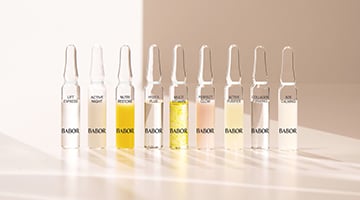
Two BABOR pages show how specific wording looks when a brand is willing to name the job. Nutri Restore Ampoule Concentrates describe ectoin as helping protect skin from UV radiation, heat, cold, and pollution. The same formula adds a micronutrient complex from Chlorella vulgaris and Lupinus albus, plus aloe vera and pro-vitamin B5. That is an ingredient-level description of environmental stress. The page also reports a separate user result: 95 percent confirmed healthier, more youthful-looking skin within 7 days. Those are not interchangeable sentences.
DOCTOR BABOR Barrier Protect Ampoule Serum Concentrate is framed as a 7-day barrier treatment with a 10 percent complex of niacinamides, ceramides, and multi-molecular hyaluronic acids, plus Biogen Plant Extract for resilience against environmental stressors. The stated outcomes are calmer-feeling skin, a more balanced look, and better moisture retention. It does not claim a particle-count study. Reading it as barrier support is accurate. Reading it as proven pollution shielding would add a test the page does not report.
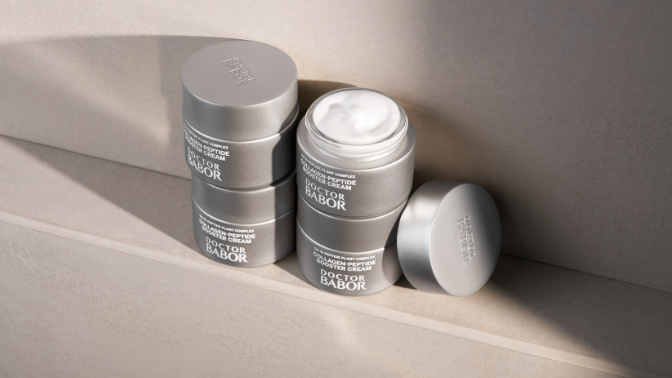
Stress Defense Mushroom Cream is a different pattern again. The page says a formula with reishi, chaga, shiitake, ginseng, and prebiotics and probiotics helps the skin's resilience to environmental stress. It also reports a clinical study in which 92 percent of users said skin felt instantly revitalized and 82 percent noticed skin appeared more resilient to external stress factors. That is a finished-product perception study about stress resilience, not a claim that the cream was proven to neutralize a named air pollutant.
How cosmetic wording stays honest
In the United States, intended use decides whether a product is regulated as a cosmetic, a drug, or both. The U.S. Food and Drug Administration explains that cosmetics are articles intended for cleansing, beautifying, promoting attractiveness, or altering appearance. Drugs include articles intended to diagnose, cure, mitigate, treat, or prevent disease. They also include articles intended to affect the structure or any function of the body. A product can be both when it has two intended uses. Firms can violate the law by marketing a cosmetic with a drug claim.
For a shopper, that legal line is also a writing test. Appearance, comfort, and the look of fatigue belong in cosmetic language. Preventing pollution-related disease, repairing DNA, or treating dermatitis does not, unless the product is actually marketed and regulated for that drug purpose. BABOR's professional formulas are cosmetic skincare. This article does not treat them as drugs, and it does not place the brand in a medical category.
"Dermatologist tested" is not decoration. It usually speaks to tolerance supervision, not to a pollution endpoint. If a page uses the phrase, look for the product, the panel, and the outcome. Do not let it certify a measurement the page never reports.
The same caution applies to antioxidant language. Vitamin C, vitamin E, and other antioxidants are often discussed because pollution exposure is linked with oxidative stress in the research literature. That scientific context is not a product result. If you want the ingredient-evidence questions, read how to evaluate clinical skincare ingredients. This page will not rank actives or repeat that framework.
A short routine for reading the label
Use one pass on the product page before you add another serum. You are looking for fit and honesty, not for a single hero ingredient.
- Underline the exposure words. Keep the product if they match your day: commute dust, dry heated air, sun plus city air, or a vague "environmental stress" you can accept as comfort care.
- Separate the mechanism sentence from the result sentence. Ectoin "helps protect from pollution" is a mechanism description. A seven-day user percentage is a result. They can both be true and still measure different things.
- Check the format. A sealed ampoule concentrate is a short course. A daily cream is a leave-on step. Do not expect a one-week ampoule test to describe a month of cream use.
- Match texture to how skin feels after time outside. Tight, dull, or easily flushed skin often needs barrier comfort first. A heavy layer you will not reapply is a weak "shield," whatever the label says.
- Keep the claim inside a cosmetic boundary. Walk away from disease language, guaranteed blockage of all pollutants, or before-and-after promises that skip the method.
If the page is thin, a specialist conversation is more useful than another comparison grid. BABOR's skincare advisor is the on-site way to narrow a routine by skin type and concern. Retailers and spas that carry the brand are listed in the retailer search. People choosing a professional backbar, rather than a personal routine, can review the DOCTOR BABOR line and the partner request without treating either page as a pollution-claim study.
Match a routine to your skin concern
What this page will not decide for you
Claim literacy is not a full routine plan. Visible lines, firmness, and uneven tone still belong to the anti-aging product guide linked above. General study quality, from controls to whether a result was replicated, belongs to the science-backed skincare guide. Ingredient evidence belongs to the clinical ingredients guide. Medical and regulatory category labels are a separate topic and are not used here to describe BABOR.
Environmental-stress care can still be a rational buy when the wording matches the test. Look for a named exposure or an honest comfort endpoint, a finished formula rather than an ingredient anecdote, and language about look and feel. That is enough to compare anti pollution skincare without borrowing proof the brand did not publish.
Frequently asked questions
What does anti pollution skincare mean?
It is cosmetic care marketed to limit how city air, residue, and related environmental stress show up on skin. A precise claim names the exposure and the result, such as particle adhesion, oxidative-stress markers, or the look and feel of the skin barrier. A slogan that only says "anti-pollution" does not identify either one.
Do I need a separate anti-pollution product?
Not always. Cleansing, daily broad-spectrum sunscreen, and a moisturizer you will actually use already do a large share of the work. Add a targeted serum or ampoule when the product page states an exposure and an endpoint that match your day, and when the texture fits the rest of the routine.
How can I tell if an anti-pollution claim is tested?
Look for the finished product, the pollutant or stressor used, the measurement, the duration, and the comparison. A user quote about feeling revitalized can be valid as a perception result. It is not, by itself, a test of particulate matter. Lab data on an isolated ingredient is not automatically a result for the cream in your hand.
Are pollution-protection claims medical claims?
They should not be, when the product is sold as a cosmetic. U.S. law treats disease treatment and structure or function claims as drug territory. Appearance, comfort, and the look of stressed skin can stay in cosmetic language. BABOR products discussed here are not positioned as drugs.
Where should barrier care sit in a city routine?
After cleansing and, in the morning, alongside sunscreen. Barrier-support ampoules and creams are there to keep skin comfortable and hydrated when wind, dry indoor air, or a long commute leaves it tight. They are a support step, not a substitute for removing the day's residue or for sun protection.