Sustainable cosmetic packaging is easier to claim than to judge. A glass jar can look responsible and still hide a pump that your city will not take. A recyclable carton can sit inside a pouch that belongs in the trash. The useful question is narrower. Which parts of this package can be separated? Which of those parts does your local program accept? Does the format waste less product than a prettier alternative?
Shop single-dose ampoule concentrates
What sustainable cosmetic packaging should tell you
Start with the package in your hand, not the campaign around it. A useful claim names the component, the material, and what you are supposed to do with it. The word eco on a carton does not do that work. A leaf icon with no instruction underneath does not either.
Luxury skincare makes this harder, not easier. Heavy glass, foil stamping, and a weighty cap are often there to signal quality. Those choices can be legitimate design. They are not, by themselves, an environmental result. Read the package the way you would read an ingredient list: one item at a time, and only as far as the label actually goes.
Read four things before you treat a package as a better choice:
- Material. Glass, paper, a named plastic, or a mix. If the brand will not name the plastic, you cannot check whether your program takes it.
- Component. Jar, cap, pump, collar, carton, and any insert are separate decisions. A recyclable bottle with a non-recyclable pump is two outcomes, not one.
- Recycled content versus recyclable. Recycled content describes what the package was made from. Recyclable describes what might happen after you finish it. They are not interchangeable.
- Instruction. A specific label, such as a How2Recycle mark, tells you whether to use curbside, check locally, or use store drop-off. A vague symbol does not.
The Federal Trade Commission's Green Guides set a clear bar for the word recyclable. An unqualified claim fits only when recycling programs reach a substantial majority of communities where the item is sold. The Guides define that majority as at least 60 percent. Below that line, the claim needs a plain limit. That is why "check locally" is more honest than a blanket promise. The rule is in section 260.12 of the FTC Green Guides.
National numbers show why the limit matters. The EPA's latest published account is from 2018. Glass containers were recycled at 31.3 percent of generation. Plastic containers and packaging overall were recycled at 13.6 percent. Paper and paperboard packaging reached 80.9 percent, driven largely by corrugated boxes. Those figures are old, and they are not cosmetic-specific. They are still the federal baseline. A glass jar is not automatically recovered. A folding carton has a much stronger paper stream behind it. The source is the EPA containers and packaging data.
Bring that baseline to the shelf in one pass. If the carton says recyclable and does not name the piece, ask which piece. If it names a plastic and does not name a route, look up your city before you assume curbside. The absence of a qualifier is not the same as proof that programs are widespread.
Compare materials by what happens after use
No material wins every test. Glass is inert and widely collected, and it can feel like the luxury default. It is also heavy, which raises shipping weight, and it breaks. Plastic can be lighter and can include post-consumer content. Collection and end markets are uneven, especially once a pump, a metal spring, or a mixed collar enters the picture. Paper is the strongest recycling story in the EPA data. It still fails if a carton is laminated, foiled, or glued to a plastic window.
Weight is part of the choice, and it is easy to romanticize. A thick glass jar uses more material and more fuel to move than a lighter bottle of the same fill. That does not make glass a poor choice. It means a glass claim should sit next to a reason: product protection, reuse, or a recycling route you can actually use. A light plastic bottle with no named resin and no disposal route is not automatically the lower-impact option either.
Use the comparison below as a shopping filter, not a ranking of brands.
| What you can check | Glass | Plastic | Paper carton | Refill or single-dose |
|---|---|---|---|---|
What the claim should name. | The container only, not the lid or pump. | Resin type, and whether content is recycled. | Paper fiber, plus any window or coating. | What you keep, and what you replace. |
Typical disposal question. | Does local glass collection take this color and shape? | Is this curbside, store drop-off, or not accepted? | Is it plain paper, or a mixed pack? | Does the refill avoid a full new primary pack? |
Where it often fails. | Mixed closures, or glass in the wrong bin. | Pumps, films, and unlabeled mixed plastics. | Foil, windows, and heavy coatings. | A refill that still needs a non-recyclable pump. |
What to ask the brand. | Which pieces separate, and where each goes. | Post-consumer share, and the label designation. | Whether paper recycling accepts the carton. | How many refills the outer pack should hold. |
How2Recycle makes this easier when a brand uses it. The label scores each component, not the whole product. Widely recyclable means at least 60 percent of Americans can recycle that package through curbside or drop-off. Check locally means access is below that line. Store drop-off applies to certain plastic films at participating US retailers. Not yet recyclable means the piece belongs in the trash. The label is explained on How2Recycle's guide.
If the package has no label like that, do the same job yourself. Separate the jar from the cap. Read any resin code as an identification mark, not as a promise that your city takes it. The number inside a triangle names a plastic family. It does not mean a recycling program exists nearby. Then check the local program before you trust the symbol.
Outer cartons deserve the same pass. A plain paper box is usually the easiest piece to recycle, which matches the high paper rate in the EPA figures. Foil, a plastic window, or a heavy coating can push that carton out of the paper stream. If you cannot tell whether the finish is ink or a plastic layer, treat the claim as unfinished and look for a specific line from the brand.
Judge refills, pumps, and single-dose formats
A refill is only a reduction if you keep the outer piece and replace less material than a new full package would have used. Ask what you keep, how many times it is meant to be refilled, and whether the refill pack itself is simpler than the original. A glass jar with a replacement pod can be a real cut in material. A refill that arrives in its own decorated carton, pump, and seal may not be.
Watch the refill claim the way the Green Guides watch other environmental words. Refillable should point to a refill the brand actually sells, in a size that matches the outer pack you keep. A jar you could wash and reuse at home is not a refill system. Neither is a travel size that happens to be smaller. Ask how many refills the brand designed the outer piece to survive. Also ask whether that piece is still sold when the refill is.
Pumps and airless systems are the usual weak point. They protect a formula from air, which can matter for an active serum, and they often combine plastic, a metal spring, and a gasket. Many municipal programs do not want that mix. Treat the pump as its own line item. If the brand cannot say whether to recycle it, trash it, or mail it back, assume it is residual waste.
That protection can still be the right design. An active formula that spoils in an open jar wastes the product and the package. An airless bottle that keeps the formula stable may justify a closure you cannot recycle, if the brand says so plainly. The failure is the silence, not the pump. A clear note that the pump goes in the trash is more useful than a green icon on the carton.
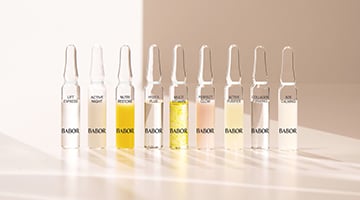
Single-dose formats answer a different problem: product left in the bottle. A concentrated ampoule uses a small sealed unit for one application, so you are less likely to throw away oxidized serum at the bottom of a pump. The packaging trade-off is the number of small units versus one larger bottle. Look at the material of the unit, whether units are boxed in paper, and whether the dose matches how you actually use the product. BABOR's ampoule concentrates are built on that single-application idea. The format is not a recycling claim. It is a way to match the amount of formula to one use.
Work through a package in this order:
- Name every piece you can take apart without tools.
- Mark which pieces the brand identifies by material.
- Check your city or county list for glass, paper, and that plastic, separately.
- Count what a refill replaces, and what it still throws away.
- Only then compare the package with another product that does the same job for your skin.
For BABOR pieces specifically, the brand publishes a sorting guide rather than a universal recyclable claim. Folding boxes go to paper recycling. Glass goes to glass collection. Caps, pipettes, and dispensers are called out on their own. Follow that page, then follow your local rules, because a German sorting instruction will not match every US cart. The guide is on BABOR's packaging disposal page.
Do not copy a European bin color onto a US cart. The guide is there so you can see how the brand separates materials. Your city decides what the truck will take. If the two conflict, the local list wins, and the honest next step is to ask the brand which piece has a US route.
Keep packaging claims inside the product decision
Packaging is one purchasing signal. It does not tell you whether a moisturizer will suit your skin, and a better carton does not repair a formula you will not use. The waste that matters most is often the product you abandon, not the jar you recycle.
Keep the two judgments apart. First decide whether the formula fits the concern, the texture you will actually apply, and the strength you tolerate. Then use the packaging checks above as a tie-breaker between products that already fit. A heavy glass jar of a cream you dislike is a worse outcome than a lighter pack of a cream you finish.
Be careful with language that slides from the package to the product. Recyclable is about collection. Recycled content is about what went into the material. Refillable should point to a real refill, not a jar you could theoretically reuse. None of those words means the formula is natural, clinical, or better for skin. Broader brand questions belong in a brand-practices review, not in a package checklist. That includes how a company sources ingredients and how specific its environmental claims are.
BABOR's own public standard separates those ideas. Conscious Beauty is the formulation standard. Sustainability and responsibility is the company-level account, including climate goals. The conscious beauty story explains the term against natural and green beauty. Use those pages when the question is the brand. Use this checklist when the question is the package.
If you are comparing two finished products, write the package notes down. Record the material of the primary container, the closure type, whether a refill exists, and what your local program accepts. That record stops a marketing line from doing the work a component list should do.
A professional routine makes the same split. You choose the formula for the skin result, then you choose the format for how the product is protected and how little of it you throw away. Single-dose concentrates, a jar you can finish, and a carton your paper bin accepts can all be reasonable. They are reasonable for different reasons. Naming the reason is the whole check.
When two products are close, prefer the one whose brand will name the piece you cannot recycle. Silence around a pump or a mixed pouch is a larger gap than a plain statement that the piece goes in the trash. You can plan for trash. You cannot plan for a symbol that means something different in the next zip code.
Frequently asked questions
Does a glass jar mean the package is sustainable?
No. Glass is often collected, and the EPA's 2018 figures put glass-container recycling at 31.3 percent of generation, not at a guaranteed recovery. You still have to separate the lid or pump and confirm that your local program takes that glass.
Is recycled plastic better than a recyclable bottle?
They answer different questions. Recycled content reduces demand for new plastic in that component. Recyclable only helps if a program near you accepts the piece and an end market exists. A bottle can be one, both, or neither. Ask for the percentage and the disposal route.
Are refillable cosmetics always less waste?
Only when the refill replaces the heavier parts and you use it more than once. Count the outer piece you keep against the pod, seal, and carton you throw away. If the refill includes another pump, the savings may be small.
What should a recycling label on a cosmetic actually say?
It should name the component and the route. How2Recycle uses widely recyclable, check locally, store drop-off, or not yet recyclable, and it does so per piece. A green arrow with no instruction is not the same thing.
Where should I confirm BABOR disposal instructions?
Use BABOR's packaging disposal page for how the brand separates paper, glass, caps, pipettes, and dispensers. Then match those pieces to your municipal list. US carts do not follow the German Yellow Bag system.